


Saturday, October 17, 2026
|
You are here: Isle of Man > Attractions > Early Historical Sites > Stone Crosses
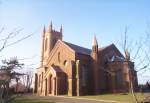
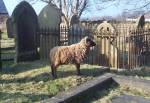
 HistoryKirk Michael Parish church holds the largest collection of Norse crosses on the Island. The church itself is of Gothic design, commissioned by Bishop Ward and completed in 1835. The churchyard holds the graves of many bishops. This would be related to its proximity to Bishopscourt, which lies just north of Kirk Michael.LocationOn the west side of the island in the village of Kirk Michael.Map Ref: SC 318 909 By Vehicle: Take the A3 running from Castletown to Ramsey, the A4 from Peel to Kirk Michael, or the A1 from Douglas to Peel and then the A4 from Peel to Kirk Michael. By Bus: Take the bus routes no. 5, 5A, or 6. servicing between Douglas, Ramsey and Peel. Also the no. 10 servicing from Peel to Kirk Michael. By Railway The west side of the Island is not serviced by the Railways. Take a vehicle or bus. The Site
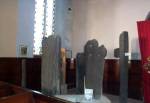
Slab with plain linear shafted cross. May date from the 6th century. Found in the Cabbal Keeill Pherie, Ballacarnane. Cross (no. 94) At one time a door lintel at Bishopscourt. The decorative design may indicate Anglican influence. Each face bears an equal limbed cross surrounded by a circular ring. One of the faces can be traced with borders ending in large double volutes and plait. The ring is decorated with a loop twist. On the right, below the circle is a spiral design. There is a crouched dog head figure elbow on knee and chin supported by his outstretched fingers. Below the volute is a hound, but the rest is worn away. The other face has a plait four design at the top and a man on horseback, armed with spear at the bottom. One edge shows plait of three. Gaut's Cross Slab (no. 101) Probably the latest piece carved by Scandinavian sculptor Gaut (around 900AD). The head is in the style introduced by Gaut and also the tendril development of the twist. These became the characteristic designs for Manx art during this period. To the left of the shaft is a plait of four. The other face bears a plait of five on the shaft with a twist and ring to to the left and a linked twist to the right. The inscription reads: Mail, Brikti, sunr, Athakans, smith, raisti, krus, thano, fur, salu, sina, sin, bru kuln, Kaut, kirthi, thano, auk ala, I maun. Meaning - Mael Bridge son of Athankan the smith erected this cross for his own soul (and that of) his brother's wife. Gaut made this and all in Man. Cross (no. 102) A broken slab, showing the lower portion of a cross. On one face there is a ring chain pattern with a twist form of link. On the other face there is a twist and ring on the shaft with patterns to the right and the remains of an inscription to the left. Inscription: (raisti kru)s, thana, af(tir) .... (A.B. erected) this cross to the memory of (C.D. his father.... Whatever may have been the relationship. Cross Slab (no. 110) The broken shaft of a cross slab, which in 1669 was turned upside down, reshaped and carved with a skull and cross bones. It shows remains of the double twist and ring design. On one edge part of an inscription reads: (A.B.) cut (these) runes Cross Slab (no. 116) This fragment has vertical and horizontal plait work, instead of diagonal, which is a characteristic of Scandinavia. Dragon Cross (no. 117) A large well carved cross with rounded top. The patterns are similar on both sides. The limbs have spaces between them and are connected to a circle before tapering off to the foot. The broad ring is decorated with plait work and loose interlacing. The looping design is Scandinavian, while the dragon, long arrow headed tails and pear shaped eyes are Norse. This cross was recorded to be in the Kirk Michael churchyard by Bishop Wilson's tomb. The bottom section was broken off and its original position is unknown. A piece of another Dragon Cross (15in high and 9in thick) was also found on the site, but was too fragmented to make a proper assessment. The cross is almost 5ft high and 2ft wide. Cross (no. 123) Only a fragment which had a double twist and ring design on the shaft of the cross. On the right there is a robed figure with long braided hair. She is holding a four pronged spear or staff in her hand. This figure possibly meant as the wise woman, Hyndla as seen on the Jurby slab. Below the figure is a tethered steed with the gold board won by Sigurd from the dragon Fafnir on its back. There are bits of a broken inscription: aiftir, mui translated as ... to the memory of Mu. Grim's Cross (no. 126) Twice pieces each showing the shaft of a cross and the beginning of a ring connecting limbs. One shows double twist, diamond shaped rings, plain twist and ring and a decorative tendril pattern. The other face had a ring chain on the shaft. The spaces at the sides are occupied with figures. Here we see Odin, armed with a spear and preceded by his wolves. Below Odin is the great fish of Valhalla. Left of the shaft, heroes fighting on Idavoll the hunting of the boar of Saebrimner. After feasting on the boar, Thor would wave his hammer over the bones and bring them back to life. Above the fallen hero is a robed figure, perhaps representing the Archangel Michael, who was the over thrower of demons and the workers of evil. Inscription:..., Krus, thna, ift, Rumun, bruthur, sun, sin. Meaning Grim raised this cross to the memory of IIromund his brother's son. Crucifixion Cross Slab (no. 129) Fragment showing the head of a cross with plain bordered ring connecting the limbs. One of the face is carved in the style of Gaut with decorated bands. At one side of the head is a Scandinavian dragon with a man and bird on the other side. The other face is more elaborately carved. The central figure must be Christ in ascension, his arms outstretched in an attitude of blessing. The cock at the side of the bead is a symbol of the Resurrection and the winged figure at the other side may represent the third I'erson in the Trinity. Inscription: ... Krims, ins, suarta. Meaning (A.B. erected this cross, etc.) ... of Grim the Black. Millumkum Cross (no. 130) A large slab carved in low relief on one face, showing a shafted cross with limbs connected by a circular ring. Shaft and circle have a cable border evening below in the head and tail of a serpent. In the centre is a ring of chain cable. The limbs contain triquetras in continuous bands. Below are plaits of nine and seven. To the left of the shaft is a hart sized by a hound and a robed Ecclesiastic with left arm raised in prayer and the right hand resting on a crutch shaped staff. At the other side, a hart and hound and man seated playing on a harp and robed figure holding a drinking horn. This must be one of the Valkyriur making an offering to Bragi, god of poetry and inspiration. Below the harper is another Ecclesiastic with arms uplifted in blessing with his right hand holding up a crutch headed staff. Below the cross and to the right has been scored the Ogam alphabet, related to the faint inscription on the middle, back of the stone, but it cannot be deciphered. Runes running up one side of the back translate as, Mal, Lumkun, krus, thena, efrer, Mal, Muru, fustra, sine, totir Tufkals, kona, is, athisl, ati. Meaning Mael Loncheu raised this cross to the memory of Mal Mura his foster (mother) daughter of Dugal the wife whom Athisl had. On the left the following reading has been done in the same hand, Betra, es, laifa, fustra, kuthan, than, son, ilan. Meaning Better is it to leave a good foster son than a bad son. Joalf's Cross Slab (no. 132) Each face is carved with a cross. The limbs of the cross connect into a circular ring. The cross is decorated with a plait of eight with four breaks giving the appearance of panels. Above and below the ring are triquet designs, below on each side is a decorative cross followed by a large boss of four triquetras. The rest of the space features subjects, stags and hounds, a man on horseback and a riderless horse. Below on the shaft are two pelleted dragons interlaced and a figure of a stag attacked by a hound. The other face shows Gaut's design. The bands goes down the shaft to form with two others in a double twist interlaced with diamond shaped rings. Above the head of the cross is a large figure of a stag followed by a hound. At the back of the stag, a bird is pursued by a larger one. At one side of the shaft a man on horseback followed by a spare horse. The other side has a bull and ram fighting a conventional bird and horse. Inscription: Iualfir, sunr, Thurulfs, hins, Rautha, risti, krus, theaft, Frithu, muthur, sino. Meaning Joalf son of Thoorolf the Red erected this cross to the memory of Fritha his mother. (Joalf is figured above the ring with a spear in his right head and a small shield in his left.) This cross originally stood in a field near Bishopscourt, but was moved to sit upon three circular stone steps just outside the gates of Kirk Michael Church. It now resides inside the church, where it can be protected. The cross is 7ft high, 20in wide, and 6in thick. Related News Articles
|
    |
|
Other Guides by Maxima Systems Ltd: Disney World